Pizza Fritta: The Danger Is the Point
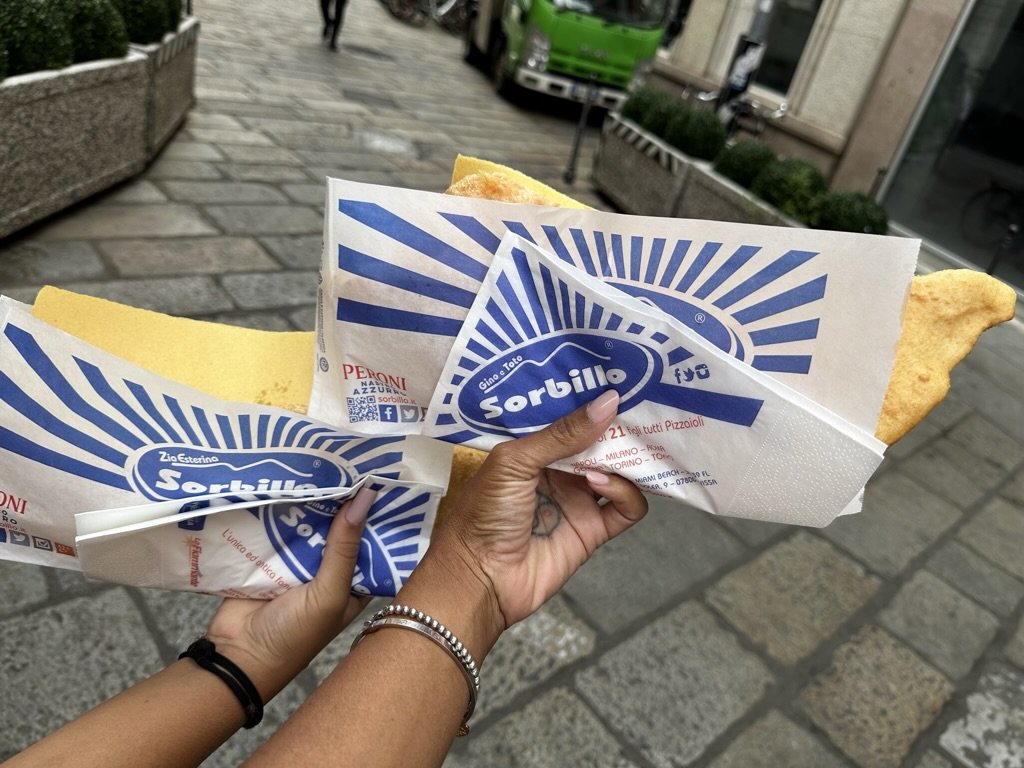
Sorbillo pizza fritta
Come Si Fa — A Summer Series
It will burn you. That is not a warning. That is the promise.
What It Is
The story of pizza fritta begins in post-war Naples, in the streets. Women fried it at home because there were no ovens and because nothing, not even a scrap of dough or a handful of food scraps, could be wasted. They sold it to passersby for a few coins. It was poverty food, cucina povera. Survival food.
The Sorbillo family has been making pizza since 1935, when Luigi Sorbillo and Carolina Esposito founded their first pizzeria on Via dei Tribunali in the ancient center of Naples, what many call the Via della Pizza Napoletana, competing with fifteen other pizzerias on the same street. They had twenty one children. All twenty one became pizza makers. Esterina was the eldest, the one who held the family together, who took over the business when her parents passed, who became the symbol of Neapolitan fried pizza. The Milano outpost carries her name. Zia Esterina. Aunt Esterina. The woman who fed a family of twenty three with hot dough and a pot of oil.
Gino Sorbillo, the family's most famous descendant, received global notoriety in 2012 when the Neapolitan mafia set his pizzeria ablaze. He reopened the next day. He has since taken the Sorbillo name as far as Miami, Tokyo and New York. The Milano location, smaller than a one-bedroom apartment, is the northern outpost of a southern dynasty.
The Conflict
So here’s a valid question that I kept asking myself when I first started frequenting this little spot: How does a Neapolitan institution not only survive, but thrive in a move north? How does street food born from poverty in the alleys of Naples retain its soul in the fashion capital of Italy?
I have eaten at the original in Naples. And I will tell you something that surprised me.
I like the Milano version better.
Something about the quality of the oil in Naples, in the overwhelming flavor of the fry, takes me briefly out of the dream. Maybe it is also familiarity. Maybe I am prejudiced. We have been going to the Milano location long enough that it has become part of our ritual, part of what Milano means to me and to Michele, for whom this is childhood food, memory food, the south carried north in a paper wrapper. I cannot be fully objective. I am not trying to be.
What I can tell you is that when those long, hot puffs of fried dough come out of the fryer and into our hands, everything else falls away.
The Experience
A circle of dough is filled with provola, ricotta, tomato and black pepper, folded into a half moon and dropped into hot oil until the exterior is shatteringly crisp and the interior is a molten pocket of smoked cheese and bright sauce. They hand it to you in a paper wrapper printed with the Sorbillo logo, blue and white, clean and proud, and you take it outside into the street.
And then the danger begins.
The heat is not incidental. It is structural. The exterior crunch gives way immediately to steam. The filling, bright tomato, slippery provola, is under pressure. Eat it from the end and the fillings funnel toward you in a controlled burn. Eat it from the top and the surface area opens up and the risk multiplies. Either way, you will be burned at least once. Either way, you will not care.
This is the point. The danger is the point. The urgency is the point. This kind of street food is not meant to be comfortable. It is meant to be immediate, hot, and gone.
We carry ours around the corner to Piazza San Fedele and eat them on a bench under the statue. Sometimes, standing up. Scorching the roofs of our mouths. Completely happy.
The Resolution
Can the simple fare of the south thrive up north? At Zia Esterina Sorbillo in Milano, the answer is yes, because they never try to dress it up. The menu has a few simple options, all of them classic. The ingredients stay true to Napoli. The price stays true to the people, at an approachable €4.80. And in a city that takes its bella figura seriously, this tiny operation has the confidence to be exactly what it is, a Neapolitan street food stand that happens to be in the heart of Milano Centro, and that confidence is its own kind of elegance.
This is proletarian food. Food for everyone. Food that has been made the same way since a woman named Esterina was feeding twenty siblings on a street in Naples nearly a century ago.
Grab one. Walk to the piazza. Burn your mouth.
You are doing it right.
Zia Esterina Sorbillo, Via Agnello 19, Milano. Order at the counter. Eat outside. €4.80. Cash preferred. No reservation. No table. No ceremony. Just go.
A Guide to My Milano 2026 is available now in our store.