
The Duomo, Always
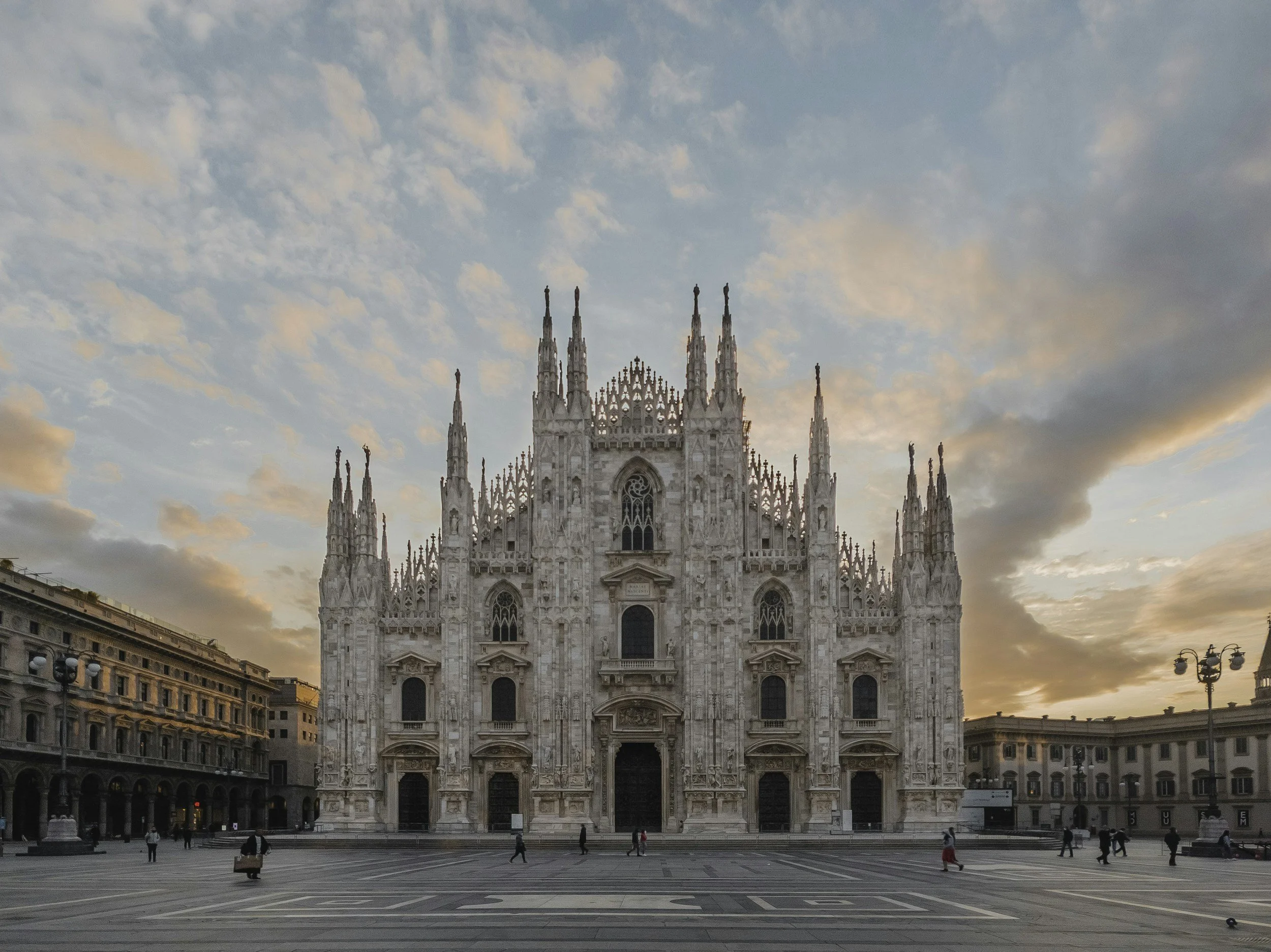
Il Duomo, Milano
Come Si Fa — A Summer Series
First you see the spires. Just a sliver of them, a cluster poking above the rooftops as you turn a corner, silver against the sky. And even after twenty years, even after dozens of visits, someone always says it. Oh, look. As if seeing it for the first time. Because in a way, you are. It is always new. Every time.
Milano’s Duomo has stood steadfast and firm for centuries but she is never the same. Kaleidoscopic, light changes her facade depending on the hour. Seasons shift her concentration of color, from bright white to warm golds or cool greys depending on the skies. The piazza beneath her is always full, a constant and softly rolling river of people flowing in and out and around her, but even they are different every time, coloring her energy from below in distinctive ways on any given day. She is like a mirror for you too, because when you look up at her you realize that you are different and ever-changing too, how much you have evolved since the last time you laid eyes on her.
Every summer, after we drop our bags, shower and reset after our long journey, we head out without anyone needing to say overtly where we are going. Something pulls us to the base of her steps, where we stand dumbly for a few moments, necks bent back, looking up. Taking in a particular tension in her presence. The weight of six centuries of marble that somehow reads as light, as lace, as something that should not be able to hold itself up and yet reaches toward the sky with complete confidence.
What will she show us this time, we always wonder. What will she reveal?
What It Is
The Duomo di Milano is the third largest church in the world and the largest in Italy. Construction began in 1386 under the orders of Gian Galeazzo Visconti, the first Duke of Milan, and took nearly six centuries to complete. The façade was not finished until 1965. What stands in the center of Milan today is not just a cathedral. It is a monument to collective human patience, to the kind of ambition that outlives every individual who contributes to it. Nobody who laid the first stone lived to see it finished. Nobody who finished it knew the people who began it.
The numbers alone are staggering. The Duomo is 157 meters long, 92 meters wide, and rises 108 meters at its highest spire, which is crowned by a gilded statue of the Madonnina, the little Madonna, who has watched over Milan since 1774. There are 3,400 statues on the exterior alone, more than any other building in the world. The interior holds 52 columns, one for each week of the year, soaring toward a ceiling of extraordinary stained glass that filters the light into something that does not feel entirely of this world.
It took six hundred years to build. Give it more than an hour of your time.
Why You Should Go
There are buildings that impress you and buildings that change you. The Duomo is the second kind. From the outside, the sheer scale is recalibrating. After the airport, after the highway, after the city closing in around your taxi, suddenly there it is, rising above the piazza with a confidence that makes everything around it feel temporary. You understand immediately why this is where Milan begins. Not the fashion district, not the Navigli, not the aperitivo bars. Here. This is the center of gravity.
Go inside. This is where the experience becomes personal.
The interior is vast and cool and quiet in a way that the city outside is not. The light through the stained glass shifts throughout the day, blue and gold in the morning, deep amber in the afternoon, and the windows themselves tell stories that reward a slow and patient eye. Some of the largest stained glass windows in the world, they depict the apocalypse, the lives of the saints, and scenes from the Old and New Testament in colors so saturated they seem to vibrate against the stone.
The 52 columns rise around you like a forest. There is art everywhere, accumulating in layers. The statue of St. Bartholomew by Marco d'Agrate, the saint holding his own flayed skin draped over his shoulder like a cloak, every muscle and tendon rendered in marble with such anatomical precision, reads less like devotion and more like a dare. And high above the apse, suspended forty meters in the air, a single red light bulb marks the spot where a nail from the crucifixion of Christ is said to be preserved. You could walk past both a dozen times before they register. The more times you visit, the more you see.
We each light a candle every time we come. It is a simple act and a ritual that has held much significance for our family over the years. We have lit candles in gratitude, in the years when things were going beautifully and we wanted to say thank you to something larger than ourselves. We have lit candles here in grief, for family members who were sick, for people we have lost. If you can find a quiet moment in one of the side chapels, light one. That is what the space is for.
What To Do
Book your entry in advance at duomomilano.it. The ticket machines at the door are unreliable and the lines have grown significantly in recent years. The combined ticket includes the interior and the rooftop terraces, and I strongly recommend doing both.
The rooftop is an experience entirely separate from the interior. You walk among the marble spires, taking in the gargoyles and saints and the intricate stonework not visible from the piazza below. And the views of Milan, of the city spreading out before you in every direction, give you a true sense of scale. Do not skip it.
Allow at least two hours. More if you can. Arrive in the late morning and plan to emerge into the afternoon giving yourself enough time to flow in the natural rhythm of a Duomo visit, moving from the sacred interior into the open piazza.
What Happens in the Piazza
The Piazza del Duomo is not just the forecourt of a cathedral. It is the civic heart of Milan, the place where the city gathers when something matters. On our most recent visit we walked into the piazza to find hundreds of people standing in near silence, holding an enormous roll of paper that stretched across the cobblestones. On it were written the names of children killed in Gaza. The rally was quiet, somber, and deeply moving.
This is not unusual for the Duomo piazza. Throughout its history this space has held coronations and protests, celebrations and mourning, the full range of what it means to be a city with a conscience. Napoleon was crowned King of Italy here in 1805. Pope John Paul II held mass here. The piazza has absorbed centuries of human history. When you stand in it, you are standing in a place that has always been used for gathering, for witnessing, for saying out loud the things that matter most. Whatever is happening there on the day you visit, pay attention. It is part of the experience.
After, find a table. There is always a spritz. Camparino in Galleria, the historic Campari bar inside the Galleria Vittorio Emanuele II steps from the piazza, is the right choice if you want beauty with your aperitivo. Art Nouveau interior, mosaic floors, the glass dome overhead. Order a Campari Spritz and let the afternoon unfold.
This is how we begin every visit to Milan. Not because it is on every tourist itinerary, but because it is true. The Duomo is always first. Everything else follows.
Duomo di Milano — Piazza del Duomo, Milan. Book timed entry in advance at duomomilano.it. Combined interior and rooftop ticket recommended. Allow at least two hours.
Camparino in Galleria — Piazza del Duomo 21, Milan. No reservation needed for the ground floor bar. Order the Campari Spritz. Open daily.
A Guide to My Milano — coming soon. Subscribe at ciaoyoaloha.com to be first to know.