
This Is How You Arrive in Florence
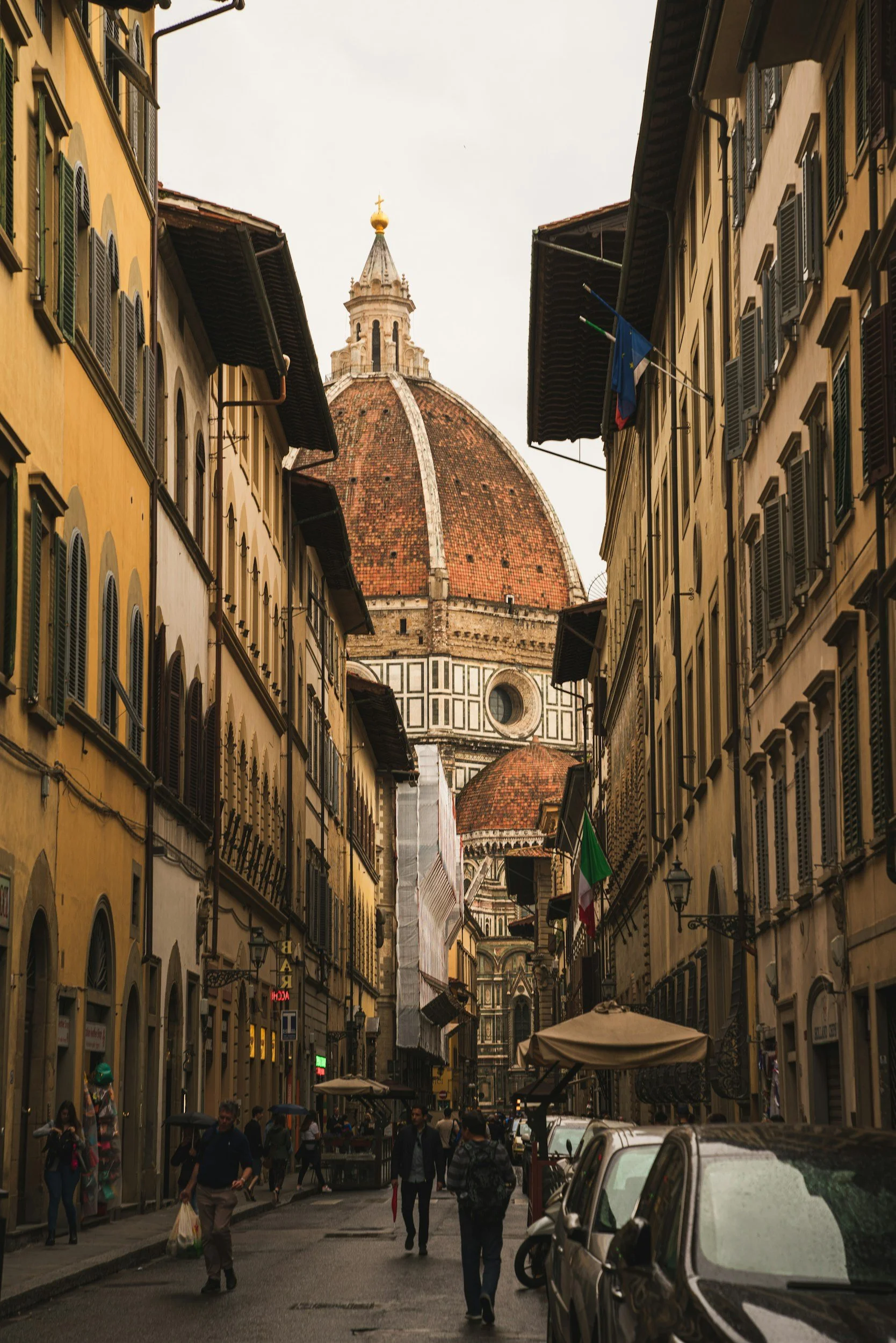
Florence street appraching the Duomo
The gray of Milan dissolves behind you first. Then the highway opens onto hills, green and rolling and speckled with a brightness that could only be June. By the time you are a couple of hours out, whole fields of yellow flowers take over the landscape entirely, hinting at the golden city up ahead.
Your husband drives the way he always drives on the Autostrada, which is to say the way every Italian drives, close enough to the car ahead that an American in the passenger seat instinctively reaches for a door handle to hold on to for dear life. Trucks move past your compact car at the same speed. Lane changes happen in the exact half-second before impacts feel certain. You do not perceive this as recklessness exactly. It is more like some kind of shared, unspoken agreement about how much space is actually necessary between speeding vehicles. You make a mental note that if you are ever forced to rent a car or drive alone that you will remember to keep pace, signal early, and trust that the tailgating is cultural weather, not personal aggression.
But something else is riding in the car with you this day. Something that has nothing to do with the traffic. You have just left Milan, and your brother-in-law, behind without knowing how many more days he has to live. What you do know is that your daughter’s summer cannot be defined by grief. And that you are the person in the car who needs to be strong and steady, which is how you end up periodically calling out things like the yellow flowers, a little too brightly, mostly for the both of them.
You stop outside Modena, at an Autogrill in Campogalliano. An Autogrill is a kind of highway rest stop that has no real American equivalent. Imagine a Trader Joe's crossed with a proper Italian pantry, wine and cheese and salumi stacked beside chips and chocolate and phone chargers. It is an entire regional identity compressed into one building off of any highway all across Italy, different in Lombardia than what you will find outside of Naples. The same idea wearing a different accent.
On this particular day, you head upstairs to dine in. Usually at an Autogrill, grab-and-go is the only option. But this time you are lucky enough to stumble upon a very rare Eataly operating and offering full service. You have the tortellini in a cream sauce so simple and exceptional that it borders on being unfair. Your daughter has her go-to, a tagliatelle bolognese. Before you go back to your car and hit the road again, your husband makes his ritual stop at the espresso bar. On your way out, you grab a bag full of taralli, a Coke, some water to hold you over for the rest of the journey.
Back on the Autostrada, as you get closer and closer to Firenze, you see fewer flowers. The hills begin to give way to rooftops. Finally, you cross over a narrow bridge, over the Arno. Ochre and yellow buildings line both banks like sentries standing watch over the city bustling behind their facades.
What happens next is a part of the drive that nobody warns you about. Florence's historic center is protected by one of the strictest camera-enforced traffic systems in Italy. There are five separate monitored zones, without visible booths or barriers. Just hidden cameras reading your plate the instant you cross a line you likely didn't even know was there. Fines run well over a hundred euros per crossing and sometimes more. Which don't arrive while you're still in the country to contest them. You get them months later, at your actual home address, sometimes multiplied, since crossing into two zones by accident means two separate fines, not one. There are no workarounds for tourists to avoid these traps. No special permits. A hotel physically inside the zone can register your plate in advance. You are not staying at a hotel.
Your husband knows all of this. That is why, as you get closer and closer to your Airbnb, his voice becomes a little more shaky and shrill. His hands start to do the talking, in that uniquely Italian way, and they are saying that he is anxious and exasperated. It is a Sunday. You try to reassure him. We will be fine, you say. The normal rules don’t apply. But his eyes and hands tell you to stop. Some of this energy he is giving, you think, is about his brother. So you hold his hand and are silent until you pull up to an open parking spot across the street from your apartment.
He refuses to get out. You note, out loud, in the same sunny tone that you have been maintaining on this ride, the other cars parked nearby. He won’t budge, too afraid to get ticketed if you leave the car alone. He tells you to go ahead and check into the apartment while he and your daughter unload the car. He says that when you come back down, you will switch. You will wait at the car and he will bring the bags up.
So you cross the street and walk past a bus stop and a busy café until you reach a narrow doorway. You check your phone and tap in the code. You step into a lobby so dark and deep that your own footsteps startle you. You turn on your camera’s flashlight to find a small elevator at the far end. You open it and take in the fact that it is about the size of an airplane bathroom. Scenes from “The Talented Mr. Ripley” come to mind as you resolve to take the stairs instead. You tentatively walk up the four flights, spiraling up and up through near total darkness. Squinting to find the right apartment number, you realize that you are on the wrong floor. In Italy the ground floor is zero. So four flights mean five actual stories. You ascend one more before you finally find the right door and tap another code three times on a keypad on its face before it finally lets you in.
The apartment is its own reward. Better and bigger and grander than the photos you’d clicked through online. You take in the space for exactly ten seconds and note the soft evening light beginning to pour through the tall windows before you turn back around to get your family.
Ultimately, you all realize that there is too much luggage for one person to lug across the street in back and forth trips. Your husband is silent as you each pull your own weight. But once inside the building, he is the only one brave enough to take the ancient, groaning lift. One piece of luggage at a time, he takes three trips up and then down, while you wait in the dark lobby. You take the stairs up again and meet him inside, arranging all of your suitcases in a tidy row. “You ready?”, he asks. Yes. And you turn around and head right back out again.
At the end of the block you turn a corner and are delighted to find yourself only steps from the city’s center. You hear someone laugh out loud, an explosive and contagious sound shot out of a mass of sightseers surrounding the Duomo. These kinds of spontaneous expressions of delight are no surprise. A never-ending mosaic covers the building like a skin. The church’s face is so full of color that any reasonable person would want to let out at least a giggle. You watch first-time families, couples, solo travelers line up for selfies in front of the church. And, for the umpteenth time after more visits than you can remember, you lift your own arm and embrace your family in your own selfie in front of the church too. Because much like your ritual at the Duomo in Milan, a trip to Florence only really begins when you bind yourself to the gravitational energy of this church and let it pull you into its orbit. Only then can you carry on and begin to tick all of the city’s other boxes.
So you stop for an aperitivo near the Uffizi to set off the night. When your family raises their glasses, you say, maybe emboldened, “Here's to life!"
Next stop, Ponte Vecchio. You walk under the porticos toward the famous bridge which frame a dramatic backdrop of a sky going gold and then slowly folding into a dusty rose. You notice small boats drifting along the dappled river as you arrive at the bridge’s apex. There, a single guitarist plays to an already gathered and enthusiastic crowd. An old Florentine man leads them in stomping and clapping in open and unembarrassed delight as the sun sets directly behind the performer like something staged.
You eat that night at Cinghiale Bianco. It is one of a handful of places in Florence that has become, over these last few years, one of the closest things you have to a second home in this city. The owner greets you before you’ve even settled at the table, and within a few niceties remembers you completely. Your visit last year, Maui, the fact that your husband got his start in America working alongside his old friend Giovanni at Bar Pitti. He sends over a truffle sfizi which delights you. Checks on you twice more before the night is through. You leave satiated, satisfied and feeling seen.
Gelato follows. Gelateria dei Neri. Then the walk home. The sky is dark now. Street lights throw orbs across the black river. The city is quiet, seems smaller. Its daytime exuberance tucked away. You whisper as you walk the rest of the way home, slowly and with no urgency.
Later, on the apartment's small balcony, you sit with your husband before turning in. You hold his hand and take in the city's skyline. The Duomo's dome catches the last of the night's ambient light. Something flits above the rooftops, dark and quick. Then another. Then more, cutting low across the terracotta in the near-dark. Birds. Bats? You are not quite sure. You only know that you’ve never noticed them before. And that you are noticing everything tonight. The light. His hand. The quiet of this city at this hour. The way that you are both quietly bracing, with neither of you saying a word out loud, for a phone call. You don't know when it will come. You only know that this, right now, is the only life you have. This exact night, his strong hand, this moment. Before whatever comes tomorrow.
A Guide to My Milano 2026 is available now. A Guide to My Florence 2026, and everything that came after that night, is coming soon.